




 Spanish
 CALL FOR A QUOTE
 Highest Quality Lumber
 Direct From The Mill Pricing
 Statewide Delivery in Colorado

Trex vs TimberTech vs Fiberon [2026]: Composite Decking Brands Compared
What You Need to Know Before You Buy
Picking the right composite decking brand doesn't have to be complicated. Here's what matters most for your Colorado deck project:
• Trex wins on sustainability and scratch resistance - 95% recycled content makes eco-conscious homeowners happy, plus those boards resist scratches better than the competition.
• TimberTech keeps things cool with the best color selection - Their Advanced PVC stays 30 degrees cooler than other brands, and you'll love their color options for hot Colorado summers!
• Fiberon delivers superior wet traction at 0.75 COF - Perfect for areas that see moisture, plus 24 color choices keep your options wide open.
• Four-sided capping beats three-sided protection every time - Complete moisture protection means your deck lasts longer and looks better.
• Pricing overlaps across all three brands ($5-15 per sq ft) with solid 25-50 year warranties, so focus on performance features instead of just cost.
Your priorities should drive your choice: want sustainability? Go Trex. Need heat resistance? TimberTech has you covered. Worried about slip safety? Fiberon's your answer.
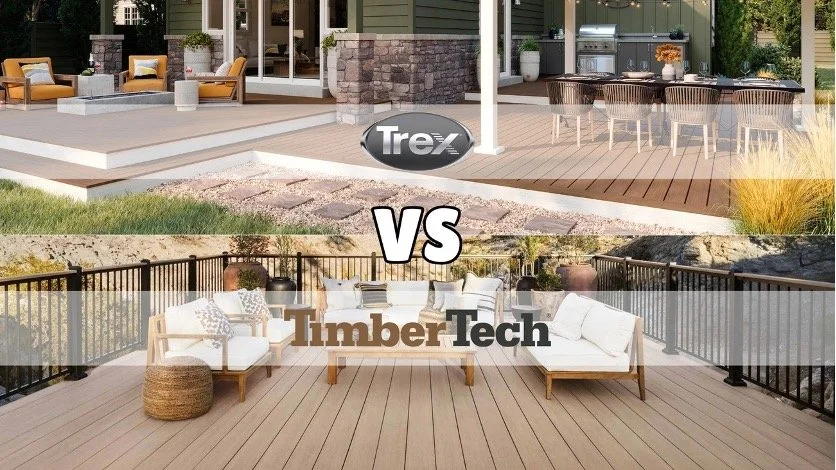
Composite decking brand comparison gets straightforward when you know what to look for. Trex, TimberTech, and Fiberon lead the pack, each bringing something special to your outdoor project. Trex uses 95% recycled materials and keeps over 90% of customers satisfied with longevity and easy maintenance. These best composite decking brands back their products with 25 to 50-year warranties, while wood decks need replacement every 10 to 15 years.
We're breaking down everything you need to compare composite decking brands - material makeup, capping technology, performance numbers, and real pricing. This composite decking brands comparison focuses on what Colorado homeowners and contractors need to know most.
What You Need to Know About Composite Decking Materials
Composite vs Wood: The Real Difference
Here's what sets composite apart from traditional wood decking. Composite boards blend wood fibers with plastic polymers to create materials that won't rot, splinter, or attract termites. You'll never need to stain or seal these boards year after year like wood decks require.
Wood decks crack and warp when Colorado weather hits them with moisture and temperature swings. Composite materials stay stable through our varied climate conditions. The manufacturing process combines wood particles—sawdust, chips, and fiber pieces—with polyethylene or polypropylene plastic. Heat and extrusion form these into deck boards where wood fibers give you natural looks and rigidity while plastic delivers the moisture resistance and durability you want.
Recycled Content: , Fiberon 94%, TimberTech 50-100%, Trex 95%
Trex leads with ICC-ES SAVE certification confirming 95.4% recycled content in their products. They source reclaimed wood from furniture manufacturers (100% pre-consumer) plus polyethylene plastic (35% pre-consumer, 65% post-consumer). The company recycled over 1 billion pounds of waste polyethylene film and reclaimed wood in 2021.
Fiberon builds boards with about 94% recycled materials—half recycled wood, half recycled plastic. Their facility processes around 100 million pounds of plastic each year. That prevents nearly 1 million trees from being cut down annually.
TimberTech uses 65% to 85% recycled materials depending on which product line you choose. Their Advanced PVC products contain approximately 60% recycled content, including post-construction materials like vinyl siding.
Why Polymer Capping Technology Matters
Capped composite decking wraps a protective polymer shell around the composite core during manufacturing. This protective cap uses high-density polyethylene, polypropylene, or PVC to block moisture, UV rays, and stains from reaching your boards. Early composite boards without capping faded faster and broke down quicker. The polymer layer stops mold and mildew from getting into the wood-fiber core, which means your deck lasts beyond 25 years.
Brand Breakdown: What Sets Each Composite Decking Leader Apart
Trex Decking: Product Lines from Enhance to Transcend
Trex builds their reputation on five distinct product lines, each targeting different project budgets and performance needs. Trex Enhance serves as the budget-friendly option starting at $5.00 per square foot, featuring a scalloped profile for lighter weight handling. The line includes 10 colors across two collections: Enhance Basics (monochromatic shades) and Enhance Naturals (multi-tonal hues resembling natural wood streaking). Trex Select occupies the mid-tier position at $8.00 to $12.00 per square foot.
Trex Transcend represents their premium tier with 6 multi-tonal colors including Havana Gold, Island Mist, Lava Rock, Spiced Rum, Tiki Torch, and Rope Swing. The Transcend Lineage and Signature lines exceed $90.00 per 12-foot board. Each step up delivers enhanced durability and more sophisticated color blending.
TimberTech and AZEK: vs PVC Options
TimberTech takes a different approach, separating their products into composite and PVC categories to serve specific performance needs. TimberTech PRO composite boards provide 4-sided polymer capping with 30-year fade and stain warranties. The PRO line includes Terrain, Tropical, and Legacy collections featuring wood-grain patterns.
AZEK products contain 100% polymer with zero wood fibers. AZEK decking stays up to 30 degrees cooler than competing composite products and offers 40% better traction when wet. The AZEK line carries a 50-year fade and stain warranty plus lifetime structural coverage. This makes AZEK particularly valuable for Colorado's intense sun exposure.
Fiberon Decking: Good Life to Promenade Series
Fiberon's Good Life series costs approximately $45.60 per 12-foot board. Good Life boards feature 3-sided cap layers and contain 96% recycled material. The Escapes Collection offers multi-tonal colors resembling exotic hardwoods., while Weekender provides solid colors for traditional stained deck appearance.
Fiberon Promenade uses premium PVC construction at $92.40 per 12-foot board with 4-sided capping. Promenade includes 6 beach-inspired colors with synthetic solid-core construction. This top-tier line competes directly with AZEK for premium performance.
Capping Differences: Why 4-Sided Beats 3-Sided
Four-sided capping wraps the polymer shell around all board surfaces including grooves and undersides. This complete encapsulation prevents moisture intrusion from ground contact and airborne humidity. Trex boards feature 3-sided capping across their entire range, leaving the bottom uncapped to allow moisture escape.
TimberTech PRO and Fiberon's premium lines (Concordia, Promenade) provide 4-sided protection delivering superior mold and mildew resistance. For Colorado homeowners dealing with snow melt and summer storms, this extra protection matters.
Color Variety and Realistic Wood Grain Textures
Fiberon provides 24 color options across collections. Trex offers 23 color choices focusing on classic earth tones. TimberTech delivers the broadest color selection with light tones, dark tones, multi-chromatic options, and natural wood-like shades.
TimberTech uses 4 degrees of color blending: solid, color-blended, highly color-blended, and uniquely color-blended for reclaimed wood appearance. Grain patterns include cathedral, crosscut, wire-brushed, hand-scraped, and straight grain finishes. This variety helps homeowners match any architectural style.
Scratch Resistance: Which Brand Holds Up Best
Trex Transcend demonstrates superior scratch resistance compared to TimberTech Tropical and AZEK Vintage in independent contractor testing. Fiberon's Horizon and ProTect Advantage lines rank among the most scratch-resistant options available.
TimberTech AZEK PVC boards offer harder, more scratch-resistant surfaces than composite products since color embeds in the plastic rather than applying on top. PVC materials generally outperform wood-plastic composites for scratch durability, with AZEK backed by lifetime limited warranties. This becomes crucial for high-traffic family decks.
What Really Matters for Your Deck's Performance
Moisture Protection That Actually Works
Polymer caps create a barrier that keeps water out of your deck boards. The protective shell stops moisture from reaching wood fibers in the core, which prevents mold and mildew from taking hold. stays structurally sound even when Colorado's spring rains stick around for days. This low absorption rate means your boards won't twist or crack when they get soaked.Capped composite decking
Heat Management: Why Your Feet Will Thank You
CoolDeck technology cuts heat absorption by 35% compared to standard capped boards. TimberTech Advanced runs up to 30 degrees cooler than competing composite products. Here's what you need to know about color choices: lightest shades hit 167°F in testing, dark brown reached 190°F, and black composite topped out at 200°F. Your bare feet will definitely feel the difference.PVC decking
Traction When It Counts
COF ratings of 0.5 or higher mean slip-resistant performance in wet conditions. Trex Transcend scores 0.52 dry and 0.39 wet. Fiberon PVC delivers the best wet traction, & composite boards measure 0.40 dry and 0.31 wet. at 0.80 dry and 0.75 wet
Warranty Coverage You Can Count On
Trex backs their products with 25 to 50-year limited residential warranties covering material defects, fading, and staining. TimberTech goes further with lifetime product warranties on Advanced PVC plus 50-year fade and stain coverage. Fiberon Promenade includes lifetime structural warranties and 50-year stain and fade resistance.
What You'll Actually Pay: Pricing and Installation Reality Check
Material Costs per Square Foot by Brand
Trex composite deck boards range from $5.00 to $15.00 per square foot depending on the product line. Trex Enhance costs $5.00 to $7.00 per square foot, Select runs $7.00 to $9.00, and Transcend reaches $10.00 to $12.00 per square foot. TimberTech pricing spans $6.00 to $13.00 per square foot. TimberTech Edge starts at $5.70 to $7.50, PRO runs $9.00 to $12.00, while AZEK commands $11.00 to $13.50 per square foot. Fiberon boards cost $4.48 to $13.18 per square foot. Good Life begins around $5.00, Concordia averages $11.00 to $13.00, and Promenade reaches $15.00 to $16.00 per square foot.
Here's the reality: all three brands overlap significantly. You're looking at similar price ranges whether you choose Trex, TimberTech, or Fiberon. Your decision should focus on performance features rather than hunting for the cheapest option.
Total Installation: What to Expect for Labor
Professional installation fees typically range from $24.00 to $48.00 per square foot. Labor costs for installing composite decks run $15.00 to $40.00 per square foot depending on deck complexity and site conditions. Installation for a 200-square-foot deck costs between $4,800 and $9,600 in labor alone.
Call us today and tell us about your project! Our knowledgeable specialists will happily chat with you about material and measurements and see how we can help you get accurate pricing for your specific situation.
Smart Budget Choices for Every Price Point
Trex Select delivers durability with shell technology at budget-friendly pricing. Fiberon Good Life provides tough finish protection without painting or staining requirements. TimberTech Prime+ offers accessible pricing with 25-year limited warranties for residential applications.
You don't need to break the bank to get quality composite decking. These mid-tier options give you excellent performance without premium pricing.
Maintenance: Your Ongoing Investment
Composite decking requires occasional cleaning with soap and water, costing around $50.00 annually. Wood decks require several hundred dollars yearly in staining, sealing, and repair materials.
Think about it this way: composite pays for itself through reduced maintenance costs. You'll save hundreds of dollars every year compared to traditional wood deck upkeep.
Side-by-Side Comparison: What Matters for Your Deck
Here's everything you need to know about these three composite decking leaders, broken down into the features that matter most for your Colorado project!
| Trex | TimberTech | Fiberon | |
|---|---|---|---|
| Recycled content | 95% (95.4% ICC-ES SAVE certified) | 50–100% (65–85% depending on product line; Advanced PVC uses 60%) | 94% (split evenly between recycled wood and plastic) |
| Product lines | 5 lines: Enhance, Select, Transcend, Transcend Lineage, Transcend Signature | Composite lines: PRO (Terrain, Tropical, Legacy); PVC line: AZEK | Good Life, Escapes Collection, Weekender, Concordia, Promenade |
| Capping technology | 3-sided capping across entire range | 4-sided polymer capping on PRO composite boards; AZEK is 100% polymer | 3-sided cap on Good Life; 4-sided capping on premium lines (Concordia, Promenade) |
| Price range (per sq ft) | $5.00–$15.00 (Enhance: $5.00–$7.00; Select: $7.00–$9.00; Transcend: $10.00–$12.00) | $6.00–$13.00 (Edge: $5.70–$7.50; PRO: $9.00–$12.00; AZEK: $11.00–$13.50) | $4.48–$13.18 (Good Life: ~$5.00; Concordia: $11.00–$13.00; Promenade: $15.00–$16.00) |
| Color options | 23 colors, classic earth tones | Broadest selection — light, dark, multi-chromatic, natural wood-like shades | 24 colors across collections |
| Warranty coverage | 25–50 year limited residential; covers material defects, fading, and staining | Lifetime product warranties on Advanced PVC; 50-year fade and stain coverage | Promenade: lifetime structural + 50-year stain and fade resistance |
| Scratch resistance | Transcend shows superior scratch resistance in independent testing | AZEK PVC offers harder, more scratch-resistant surfaces than composite; lifetime limited warranties | Horizon and ProTect Advantage lines rank among most scratch-resistant options |
| COF rating (dry/wet) | Transcend: 0.52 dry / 0.39 wet | Not disclosed for composite; AZEK offers 40% better wet traction | Composite: 0.40 dry / 0.31 wet; PVC: 0.80 dry / 0.75 wet |
| Heat absorption | Not mentioned | Advanced PVC stays up to 30°F cooler than competitive composite; CoolDeck reduces heat by 35% | Not mentioned |
| Material composition | Wood fibers + polyethylene plastic (35% pre-consumer, 65% post-consumer) | Composite: wood-plastic composite; AZEK: 100% polymer, zero wood fibers | Wood-plastic composite, ~94% recycled materials |
| Customer satisfaction | Over 90% for longevity and ease of maintenance | Not mentioned | Not mentioned |
| Annual recycling volume | Over 1 billion lbs of waste polyethylene film and reclaimed wood (2021) | Not mentioned | ~100 million lbs of plastic annually; prevents ~1 million trees cut yearly |
Call us today and tell us about your project! Our knowledgeable specialists will walk you through these options and help you choose the perfect composite decking for your Colorado home.
Conclusion
Choosing between these composite decking brands comes down to your specific priorities rather than finding an absolute winner. Trex leads in recycled content at 95% and scratch resistance through Transcend boards. TimberTech offers the broadest color selection and coolest surface temperatures with Advanced PVC technology. Fiberon delivers superior wet traction ratings at 0.75 COF and competitive pricing across 24 color options.
Pricing overlaps significantly, with all 3 brands offering budget-friendly and premium options. Choose based on what matters most: recycled materials, heat resistance, slip safety, or color variety. Your deck location and intended use should drive the final decision.
FAQs
Q1. What is the main difference between composite decking and traditional wood decking?
Composite decking is manufactured from wood fibers encased in plastic polymers, creating boards that resist termites, rot, and decay without requiring annual staining or sealing. Unlike wood decks that splinter, warp, and crack when exposed to moisture and temperature fluctuations, composite materials maintain structural integrity across varying weather conditions and typically last 25-50 years compared to wood's 10-15 year lifespan.
Q2. How much recycled content do the top composite decking brands use?
Trex uses the highest recycled content at 95% (certified by ICC-ES SAVE), consisting of reclaimed wood and polyethylene plastic. Fiberon manufactures boards with approximately 94% recycled materials split evenly between recycled wood and plastic. TimberTech decking contains 65-85% recycled materials depending on the product line, with their Advanced PVC products using approximately 60% recycled content.
Q3. What does 4-sided capping mean and why is it important?
Four-sided capping wraps a protective polymer shell around all board surfaces including grooves and undersides, providing complete encapsulation that prevents moisture intrusion from ground contact and airborne humidity. This offers superior mold and mildew resistance compared to 3-sided capping, which leaves the bottom uncapped. TimberTech PRO and Fiberon's premium lines feature 4-sided protection, while Trex uses 3-sided capping across their entire range.
Q4. How much does composite decking cost per square foot installed?
Material costs range from $4.48 to $16.00 per square foot depending on the brand and product line. Professional installation fees typically add $15.00 to $48.00 per square foot, bringing total installed costs to approximately $20.00 to $60.00 per square foot. Budget-friendly options like Trex Enhance and Fiberon Good Life start around $5.00 per square foot for materials, while premium lines like Fiberon Promenade reach $15.00-$16.00 per square foot.
Q5. Which composite decking brand performs best in hot weather?
TimberTech Advanced PVC decking stays up to 30 degrees cooler than competitive composite products and features CoolDeck technology that reduces heat absorption by 35% versus traditional capped composite boards. This makes it the best choice for hot climates where surface temperature is a concern. Dark-colored composite boards can reach temperatures of 190-200°F, while lighter colors stay around 167°F.
