

 Spanish
 CALL FOR A QUOTE
 Highest Quality Lumber
 Direct From The Mill Pricing
 Statewide Delivery in Colorado

Why Your Home Depot Lumber Warps: The Truth About Big Box vs. Local Yards [Colorado Guide]
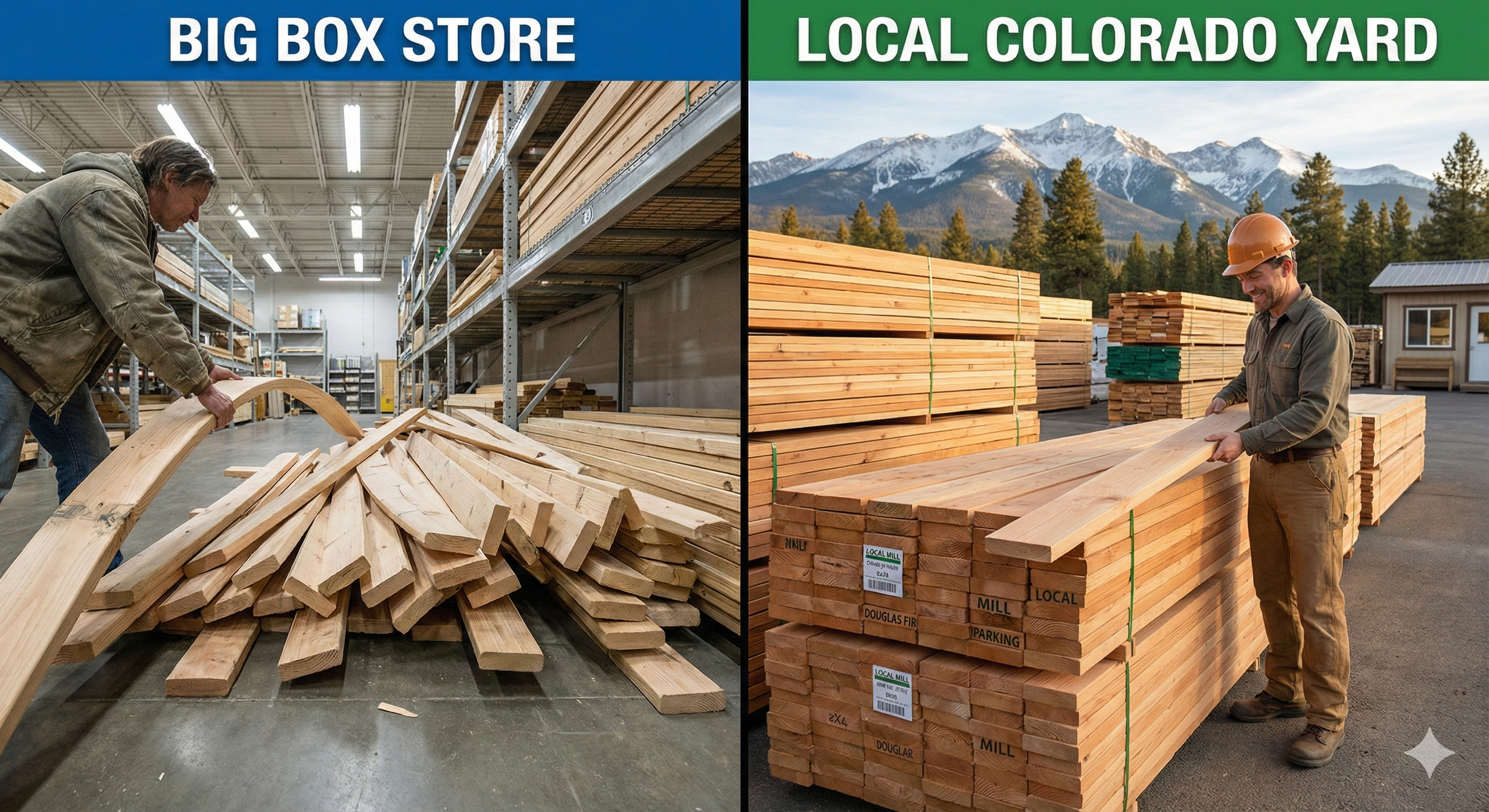
At A Glance: The Executive Summary
The Problem: Big box lumber often comes from "fast-growth" trees with high moisture content, leading to warping in Colorado's dry climate.
The Science: Wide growth rings in plantation wood make it less dense and up to 10x more prone to shrinking, cupping, and twisting.
The Reality: All natural lumber - even high-quality boards - can warp, check, or split over time because wood responds to moisture and temperature changes. RMFP's lumber simply does it far less often thanks to better sourcing, aging, and grading.
The Solution: Local yards like RMFP offer kiln-dried, slow-growth timber that is stable and graded specifically for the Rockies.
The Cost: While sticker prices at big box stores look lower, the high cull rate (waste) and replacement costs often make local yards cheaper per usable board.
Ever wonder why lumber yard vs Home Depot purchases lead to such different project results? Many homeowners believe big box stores give them the best deal on everything, including wood. This common belief doesn't hold up when you look at lumber quality and overall value.
Mass-market retailers like Home Depot prioritize volume, which often necessitates stocking faster-growth timber. Big box stores often sell construction-grade wood that shows visible defects—knots, warping, splits, or inconsistent cuts. The issue stems in part from modern plantation-grown softwoods with wider growth rings. These characteristics make the wood less dense, weaker, and more likely to warp, shrink, and split.
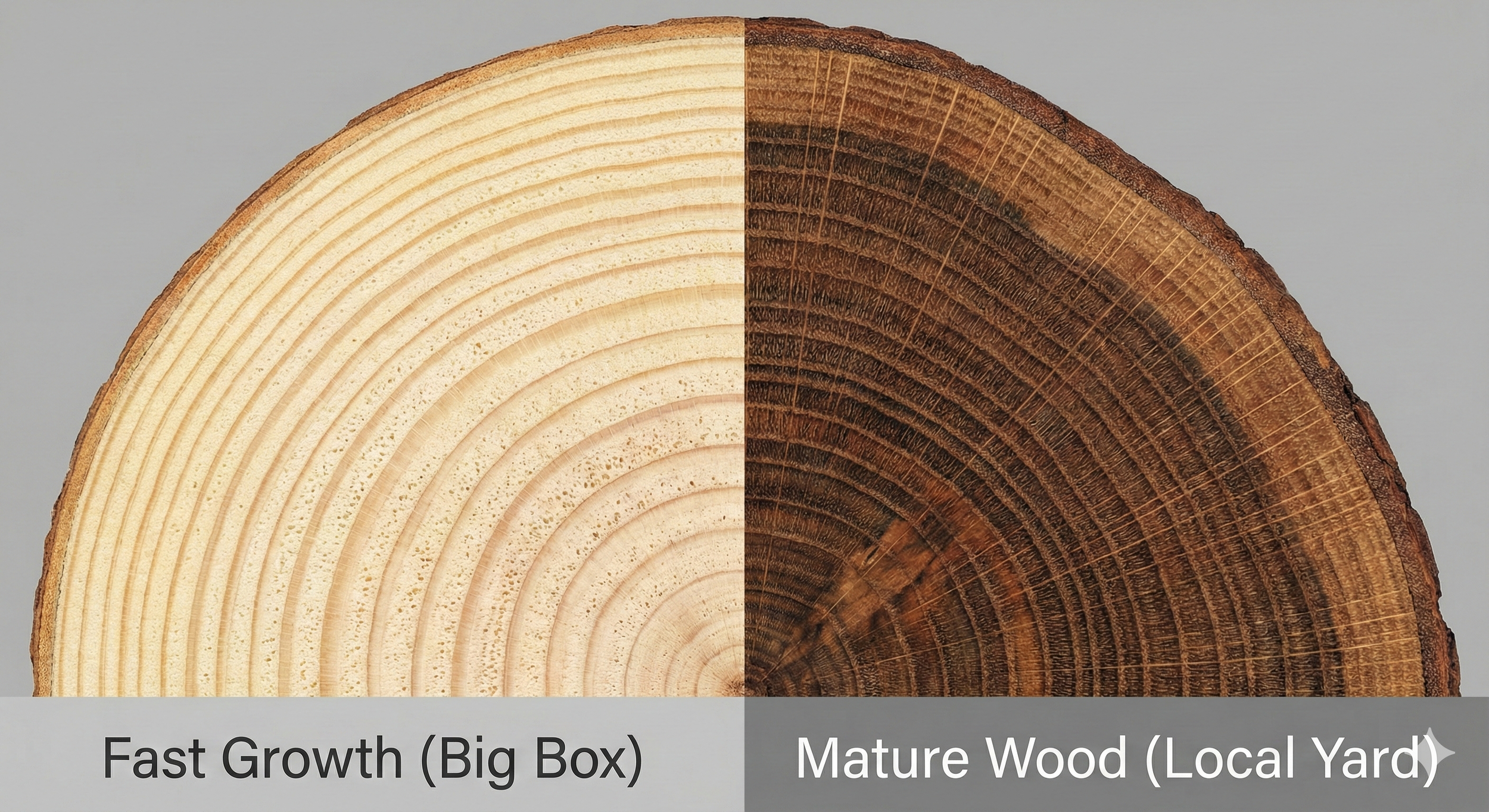
Fast-growth wood from big box stores is less dense and more prone to warping than mature timber.
Local lumber yards like RMFP in Colorado offer competitive pricing on high-quality, durable wood, contrary to what many believe. Local yards also provide better daily pricing, especially if you need bulk orders or specialty cuts. The price comparison between lumber yards and Home Depot reveals a key point - high-quality lumber from local yards can save you money over time because you'll need fewer replacements or repairs.
In this piece, you'll learn why Home Depot lumber tends to warp, see the differences between home depot wood and lumber yard options, and discover why RMFP could be your best choice for lumber in Colorado.
Why Home Depot Lumber Warps
"Big box store wood is notorious for warping and twisting after you get it home" — Woodworking Expert (731 Woodworks), Professional woodworker and YouTube content creator specializing in lumber quality and woodworking techniques
The issues with big box store lumber start way before you see it on shelves. Let's get into why lumber from Home Depot tends to warp and how a local Colorado lumber yard like RMFP gives you better options.
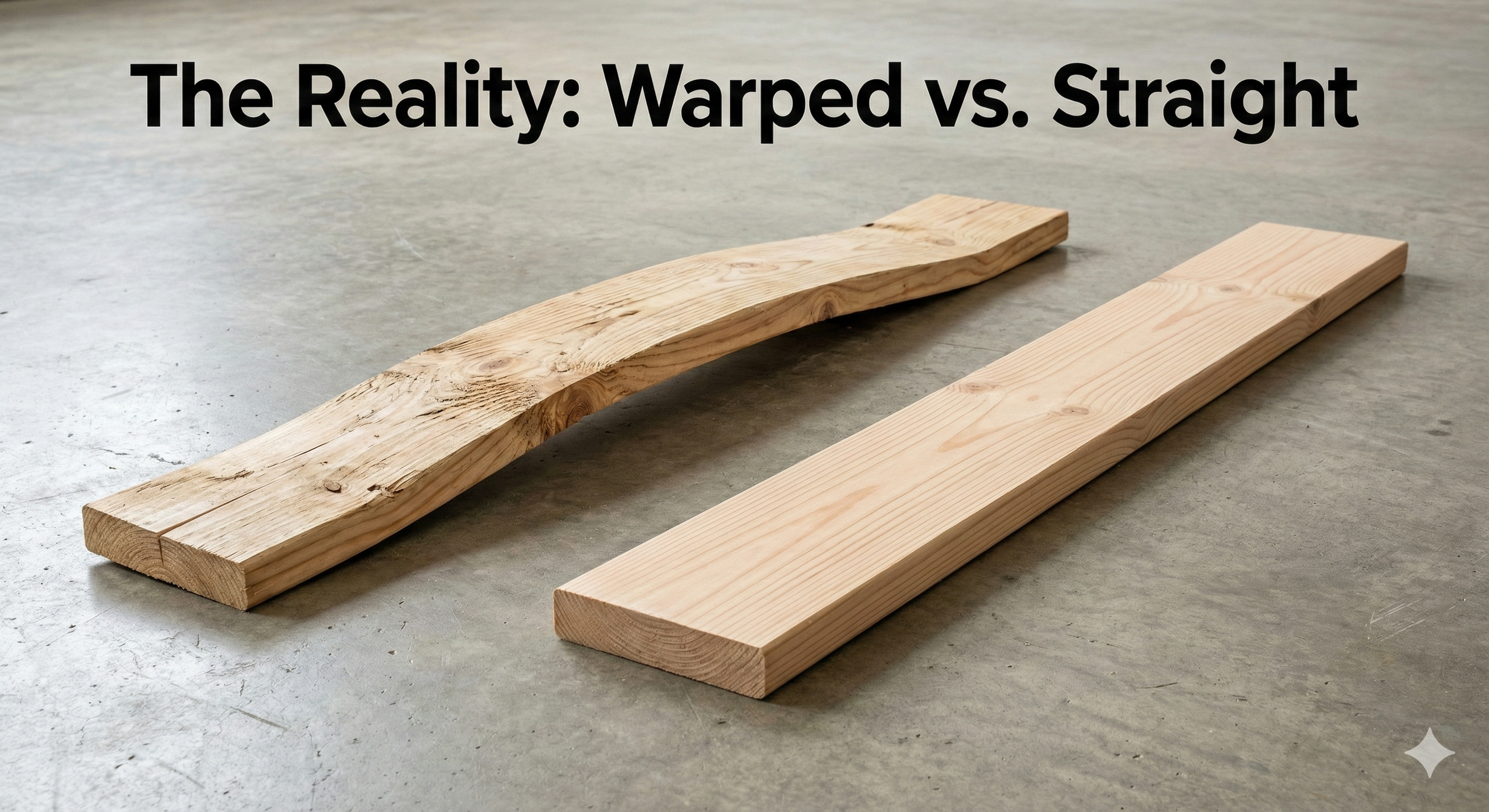
Proper drying and storage at local yards prevent the twisting common in big box lumber.
Fast-growth plantation wood and its downsides
A walk through Home Depot's lumber section shows mostly fast-growth plantation timber. These trees get harvested much younger than traditional lumber, which creates quality problems. Fast-grown trees have more juvenile wood that shrinks along the grain up to 10 times more than mature wood [1]. This juvenile wood rarely meets higher strength grades when tested through machine-stress-rating.
The collateral damage is clear - juvenile wood just isn't as strong or stable. Trees that grow too fast develop wider growth rings and less dense wood. These structural weaknesses can't be fixed no matter how carefully you handle the wood.
Mass production and poor quality control
Big box stores put quantity before quality. Many sawmills ship lumber straight to distribution centers without letting it dry properly [2]. So what looks straight on the shelf might twist and warp once it's in your home.
Standard big-box drying processes are often accelerated, which can leave core moisture higher than local kiln-dried standards. [2]. They just want to move large amounts of product fast instead of making sure each piece meets quality standards [3]. This creates systemic problems when you look at lumber yard vs Home Depot options.
Improper drying and storage conditions
Wood warps mainly because of moisture content. Proper lumber drying needs careful control of temperature, humidity, and air flow [4]. Big box store lumber often misses out on this careful treatment.
Wood that dries too fast or unevenly develops internal stress that causes checking, splitting, and warping [5]. This happens mostly during the original drying when the wood has the most moisture. The outside dries and shrinks before the inside, which guides the wood to warp [5].
These basic differences explain why lumber yards offer better wood despite what many think about prices. Instead of asking "is lumber cheaper at a lumber yard?" think over the long-term value of properly dried, stable lumber that won't ruin your project.
Lumber Yard vs Home Depot: Quality and Selection
The quality difference between a local lumber yard vs Home Depot is clear. Local yards provide superior wood that works better in your projects.
What makes lumber from a yard better?
Local lumber yards stock higher-grade lumber that you rarely find in big box stores. You'll discover carefully selected wood that's straighter, drier, and has fewer defects [6]. Big box stores stock mostly #2 and #3 construction-grade lumber with varying straightness and moisture levels [6]. The lumber yard's focus on wood as their main product, rather than just one department, makes a real difference.
The staff's expertise adds value to the lumber yard experience by a lot. The core team at lumber yards brings years of specialized knowledge, unlike big box stores with seasonal workers. RMFP's salespeople have multiple years of experience with almost 50 years of combined knowledge to help with projects of all types [7]. Their expertise helps you pick materials that work best in Colorado's unique climate.
Types of wood available at RMFP in Colorado
RMFP's selection of hardwoods and softwoods includes:
Hardwoods: Ipe (Brazilian Walnut), Garapa, and Fijian Mahogany [7]
Engineered options: Composite materials from brands like Trex®, TimberTech®, and Fiberon [8]
The yard stocks materials to fit specific project needs, including custom timbers, Douglas Fir beams, and pergola packages [8]. Contact RMFP today to get high-quality lumber that won't warp like big box store options.
How local yards maintain quality standards
Quality grading transparency sets these yards apart. Big box stores often mix multiple grades together, making quality hard to predict [7]. RMFP gives you three clear choices: rustic, standard, and premium - so you can pick what matches your project needs [7]. Local sourcing of wood means it suits regional conditions better [10].
Professional contractors choose lumber yards because they need structural integrity and longevity in their projects.
The "Mill Direct" Difference: Why RMFP Prices Actually Beat Big Box
Most homeowners assume Home Depot is cheaper simply because they are a massive corporation. The truth is in the supply chain. RMFP beats big box prices on many products not because we cut corners, but because we cut out the middlemen.
The "Middleman Markup" Trap
To understand why you pay more at a big box store, you have to look at how the wood gets there.
The Big Box Route: Forest → Sawmill → Remanufacturer → Corporate Distributor → Retail Store → You.
Result: Every stop adds a markup to the price tag.
The RMFP Route: Forest → Sawmill → RMFP → You.
Result: We buy directly from the source. By removing the corporate distributors and remanufacturers, we pass those savings directly to you.
Is lumber actually cheaper at a local yard?
Yes. Because of our Mill Direct model, our shelf price often beats Home Depot on common cedar, siding, and fencing materials. You aren't paying for the "convenience" of a retail chain; you are paying for the wood.
Why Local Yards Like RMFP Are a Better Choice
The lumber yard you choose affects your entire project experience beyond just price and selection. Service quality often determines whether Colorado homeowners and contractors should pick a lumber yard or Home Depot.
Expert advice and individual-specific service
You need guidance from people who really understand wood when making lumber decisions. RMFP's salespeople have over 50 years of combined experience helping with projects of all types [7]. This expertise stands in stark contrast to big box stores, where staff often rotate between departments.
RMFP's service approach stands out because of their follow-through. The core team checks back with customers throughout their projects, unlike Home Depot's transaction-focused environment. They help ensure satisfaction and provide additional guidance [7]. Their experts give specific advice about material selection and installation techniques that work best in Colorado's unique climate conditions [11].

Expert guidance ensures you pick the right materials for Colorado's unique climate.
Specialty orders
Local yards excel by providing services you won't find at big box retailers. Their extensive selection includes specialty woods and unique materials. You can find reclaimed lumber and beetle kill pine for distinctive projects [1].
RMFP's showrooms in Denver and Colorado Springs let you see finished projects made from different woods and grades [7]. Contact RMFP for all your lumber needs and experience the difference that expert service and quality materials can make for your project.
Supporting Colorado's local economy
Local lumber yards strengthen Colorado's economy directly. Each year, up to 90% of consumer spending on wood products goes to items grown, manufactured, and shipped to Colorado from elsewhere [12]. RMFP helps change this pattern.
Local lumber yards promote environmentally responsible forest management that benefits Colorado's woodlands through proper stewardship [12]. These methods reduce wildfire risks and create economic opportunities across our state's rural communities [12].
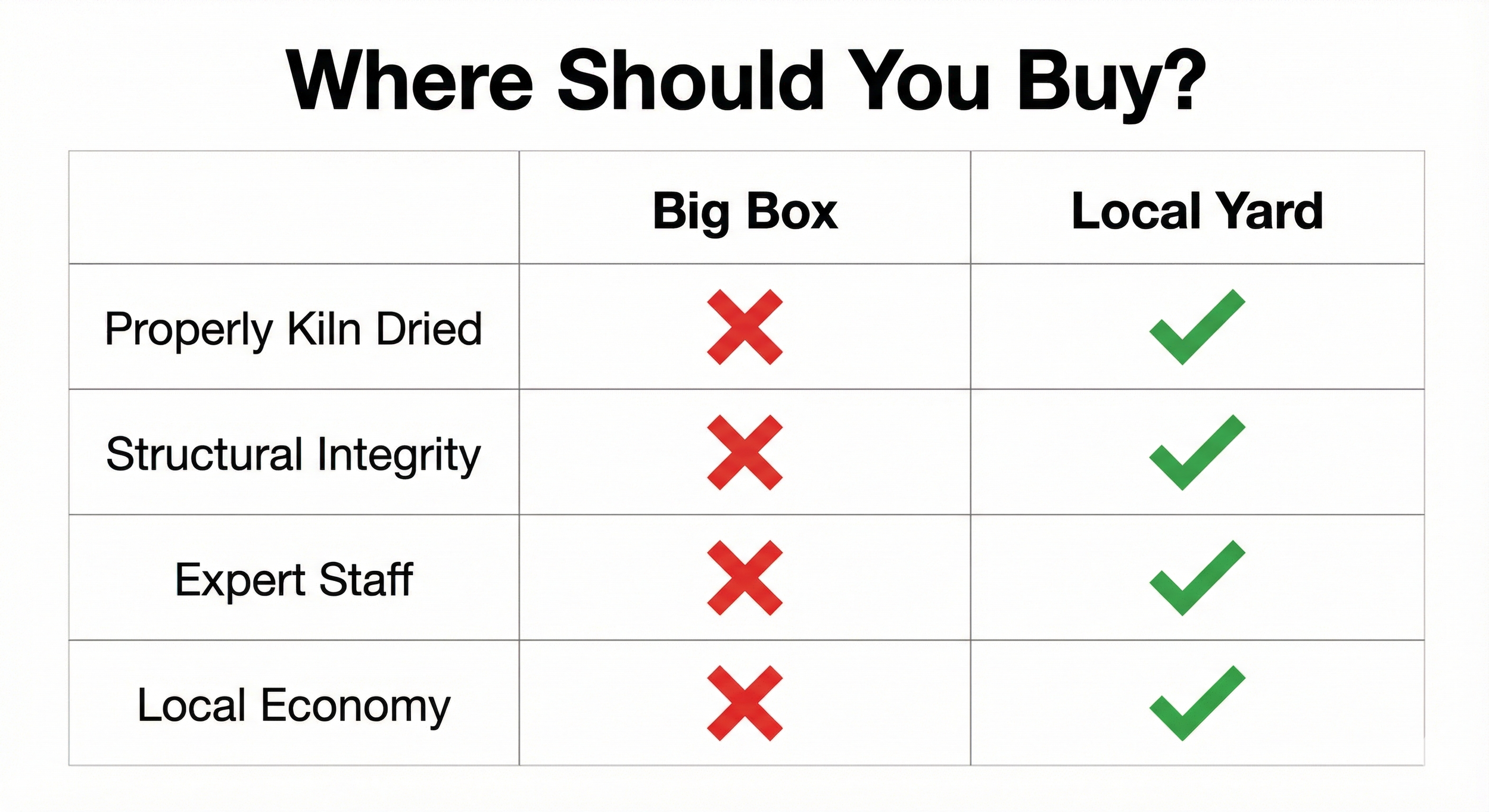
Local yards check every box for quality, service, and sustainability.
The 5-Point "Don't Get Warped" Checklist
Before you load that lumber onto your truck, check these 5 signs of potential failure:
Check the End Grain: Look for the "bullseye" (pith) of the tree. Boards containing the center of the tree are highly unstable and will almost certainly twist.
The Eye Test: Lift one end of the board and look down it like a rifle sight. If it curves left/right (crook) or twists (wind), put it back.
Knot Placement: Avoid boards with large knots near the edges (edge knots), as these create structural weak points that snap easily.
Ring Density: Look at the end of the board. If the curved rings are widely spaced (more than 1/4 inch apart), it is fast-growth wood and will shrink significantly.
Weight Test: Pick up two boards of the same size. If one feels significantly heavier, it likely has very high moisture content and will shrink/warp as it dries in the Colorado sun.
Conclusion
The choice between Home Depot and local lumber yards becomes clear for your next project. Big box stores' lumber often comes from rapidly grown plantations with poor quality control and storage. You'll end up with warped, unstable wood that wastes time and money through delays and replacements.
Quality makes all the difference between lumber yard and Home Depot purchases. RMFP's lumber is properly dried and carefully graded to suit Colorado's unique climate. The store has premium hardwoods, softwoods, and engineered options you rarely find at big box retailers.
Most people think lumber yards cost more than Home Depot. In stark comparison to this, RMFP's prices stay competitive, especially when you factor in long-term value. Their volume discounts and contractor pricing programs make quality lumber available for projects of all sizes.
RMFP's core team brings years of specialized experience to guide your decisions. Their expert advice helps you pick the right materials instead of facing overwhelming choices alone.
Your choice of RMFP supports Colorado's local economy. While 90% of consumer spending leaves our state, your purchase creates economic opportunities in Colorado's communities and promotes proper woodland stewardship.
Next time you need quality lumber that won't warp, crack, or compromise your project, RMFP is your best choice. Their superior materials, competitive pricing, expert service, and steadfast dedication to Colorado make them the clear winner for both homeowners and contractors.
FAQs
Q1. Why does lumber from Home Depot tend to warp more than lumber from local yards? Home Depot lumber often warps due to fast-growth plantation wood, poor quality control, and improper drying and storage conditions. These factors lead to less stable wood that's more prone to warping, especially when exposed to changing environmental conditions.
Q2. How does the quality of lumber from local yards compare to that from big box stores? Local lumber yards typically offer higher-quality wood that's straighter, drier, and contains fewer defects. They often stock carefully selected lumber that's properly kiln-dried and graded, resulting in more stable and durable wood for your projects.
Q3. Are lumber prices at local yards competitive with those at Home Depot? Contrary to popular belief, local lumber yards often offer competitive pricing, especially when considering bulk purchases and contractor discounts. While some premium woods might cost slightly more, the long-term value and reduced need for replacements often make local yard lumber more cost-effective.
Q4. What additional services do local lumber yards provide that big box stores don't? Local lumber yards like RMFP offer expert advice, personalized service, and specialty orders. They also provide showrooms where customers can view finished projects and receive guidance on material selection specific to local climate conditions.
Note: Home Depot® is a registered trademark of Home Depot Product Authority, LLC. This article is for educational comparison purposes only and RMFP is not affiliated with Home Depot.
References
[1] - https://www.rmfp.com/blog/blog-post-title-one-p78jz
[2] - https://www.lumberjocks.com/threads/what-causes-wood-to-warp-and-what-wood-is-least-likely-to-warp.310830/
[3] - https://penlumber.com/where-to-buy-lumber/
[4] - https://www.fpl.fs.usda.gov/documnts/fplgtr/fplgtr118.pdf
[5] - https://extension.oregonstate.edu/catalog/em-8612-air-shed-drying-lumber
[6] - https://www.adcbuilds.com/post/lumber-yard-vs-big-box-store-which-offers-better-lumber-quality-and-value
[7] - https://www.rmfp.com/blog/hardwood-lumber-colorado
[8] - https://www.rmfp.com/
[9] - https://www.jwlumber.com/2017/05/17/shop-lumber-yard/
[10] - https://centennialwoods.com/blogs/news/lumber-yard-vs-big-box-store-where-to-buy-lumber?srsltid=AfmBOoozm4OyzISC73bymBgvrw34e50hzPh8ApXRjI3vxeZbz9H6rrad
[11] - https://www.rmfp.com/decking/colorado-springs
[12] - https://csfs.colostate.edu/2023/10/18/wood-is-good-embracing-forest-products/